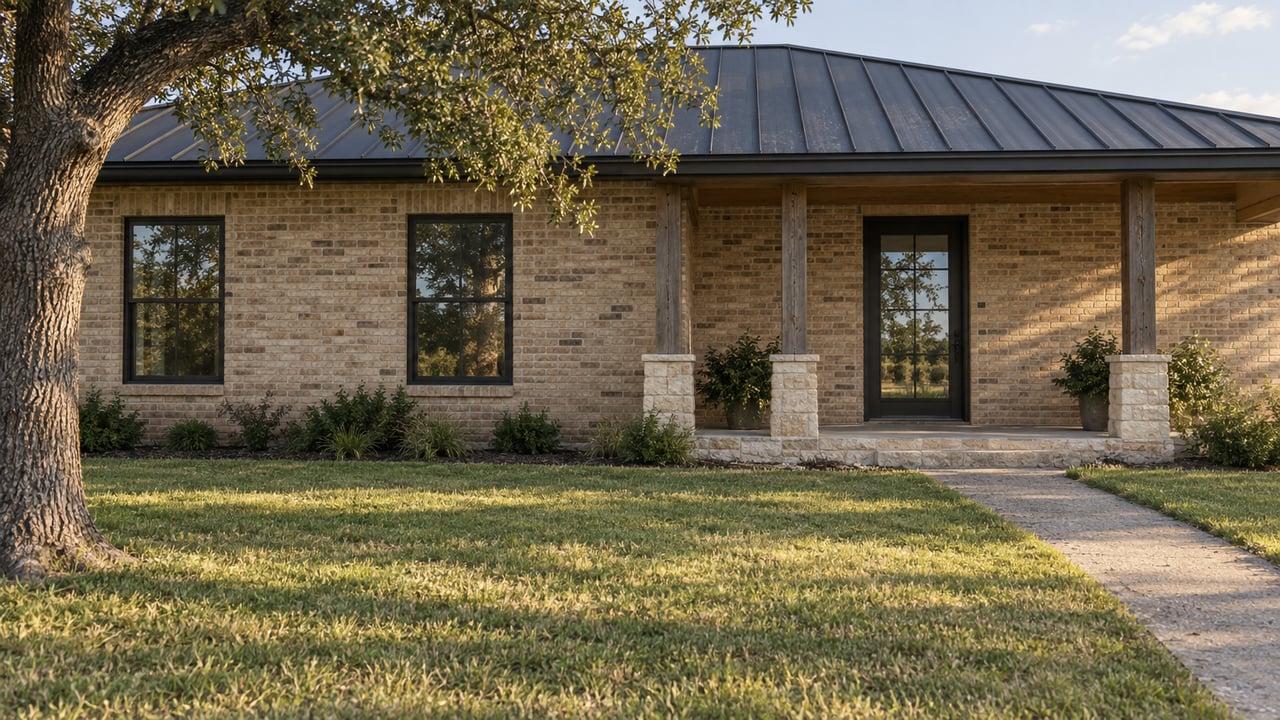
Scroll through listings around Richland Chambers Lake and the phrase turns up constantly. Move-in ready. Turnkey. Nothing to do but unpack. For buyers coming from Dallas–Fort Worth, where the term usually refers to fresh paint, updated flooring, and an HVAC system with some life left in it, the meaning feels obvious.
On a 44,000-acre water-supply reservoir with more than 330 miles of shoreline, it isn't.
A house here can be genuinely move-in ready inside — every system functional, every finish current — and still carry five figures of deferred obligation on the water side, none of which appears in the MLS description. The dock may be sound but unpermitted. The permit may exist but not transfer. The retaining wall may be holding today and failing behind the sheet piling. The septic system may work perfectly and still be out of compliance with its maintenance contract.
None of that makes "move-in ready" a dishonest phrase. It makes it an incomplete one. This guide covers what the term actually means, what it consistently leaves out around Richland Chambers, and how buyers and sellers should handle it.
The Standard Definition — And Its Limits
"Move-in ready" has no formal legal definition. It appears nowhere in Texas property code, nowhere in Texas Real Estate Commission rules, and nowhere in any enforceable standard. It is a marketing descriptor, and in general practice it implies that utilities function, structural components are safe, and nothing requires repair before occupancy. It does not promise new systems, current finishes, or flawless condition.
That distinction matters legally. A buyer cannot terminate a contract or pursue a seller simply because a home marketed as move-in ready turned out to need work. Enforceability rests on three things: the written contract terms, the Seller's Disclosure Notice, and the third-party inspection report. Marketing language in a listing is not one of them.
The Seller's Disclosure Notice — TREC Form OP-H, required under Texas Property Code § 5.008 — is where actual condition gets documented. Sellers of single-family residential property must deliver it on or before the effective date of the contract, and must disclose known defects in the foundation, roof, electrical, plumbing, and HVAC systems, along with environmental hazards, pest history, prior insurance claims, and past flooding. The standard is actual knowledge: a seller isn't required to hire an inspector to complete the form, but deliberately concealing a known material defect creates exposure under the Texas Deceptive Trade Practices Act. If a buyer receives the disclosure after signing, § 5.008 grants a statutory right to terminate for any reason within seven days.
The practical takeaway is that "move-in ready" is a starting point for conversation, not a finding of fact. For a broader breakdown of listing language, the real estate lingo guide covers the rest of the vocabulary buyers encounter.
What "Move-In Ready" Does Not Cover Around Richland Chambers
This is where lake purchases separate from suburban ones. Each item below can be entirely broken while the house itself is perfectly livable.
The dock permit, and whether it transfers
The Tarrant Regional Water District holds sole regulatory jurisdiction over every structure at or below 320.00 feet mean sea level. Because the lake's normal conservation pool sits at 315.00 feet, TRWD's flood easement extends across dry land that a buyer would reasonably assume is private property. Docks, boathouses, seawalls, and retaining walls all fall inside that jurisdiction.
Critically, shoreline permits do not transfer automatically with title. The new owner must transfer the existing permit into their own name through TRWD's MGO Connect portal within 30 days of closing. A listing can accurately describe a covered two-stall boathouse as move-in ready while the underlying permit is expired, held by a previous owner, or never issued in the first place — a situation the boathouse permit article walks through in detail.
Permitted dock size is also tied to owned shoreline frontage, not to what a buyer wants to build. TRWD allows 8 square feet per linear foot across the first 150 feet of frontage, capped at 1,200 square feet; 4 square feet per foot from 151 to 250 feet; and 2 square feet per foot from 251 to 450 feet. Setbacks require at least 5 feet from neighboring property lines, rising to 20 feet for structures over 1,200 square feet. Any marine contractor doing the work must co-sign the application and carry a minimum of $500,000 in general liability insurance naming TRWD as additional insured.
For a buyer planning to expand a modest dock after closing, frontage math determines whether that plan is even permissible.
Septic — and which county's rules apply
Richland Chambers straddles Navarro and Freestone counties, and On-Site Sewage Facility requirements differ on either side of the line.
On the Navarro County side — Corsicana, Kerens, and the northern and western shores — transferring a property with an existing conventional or aerobic system requires submitting ownership documentation and a Development/OSSF permit through Navarro County Planning & Development. A TCEQ-licensed installer or designated agent must verify the system before final utility sign-off.
On the Freestone County side, including Streetman and the southern and eastern shores, homes with surface-application aerobic systems must carry an active maintenance contract with a TCEQ-licensed provider. Inspections are mandatory every four months — three times per year — with reports filed to the county within 14 days. A house that has sat vacant through a listing period may have a lapsed contract and missed inspection cycles, neither of which affects whether the toilets flush on the day of the final walkthrough.
Bulkheads and retaining walls
Shoreline substructure is the most expensive thing a buyer can inherit and the hardest to assess visually. A wall that looks intact may have failed tie-back anchors or soil washing out behind the sheet piling — damage that becomes visible only during a drawdown year.
Repair type | Cost per linear foot | Typical 100 ft total |
|---|---|---|
Minor patching or cap replacement | $45 – $110 | $4,500 – $11,000 |
New vinyl or composite bulkhead | $180 – $320 | $18,000 – $32,000 |
New steel sheet piling | $250 – $400 | $25,000 – $40,000 |
Rip-rap or rock armor repair | $75 – $150 | $7,500 – $15,000 |
Costs shift substantially depending on soil conditions, water depth, and whether the contractor can reach the site by land or needs a barge. Steel offers the longest service life at 30-plus years; vinyl and composite resist corrosion better in this water profile.
Water service, and who holds the CCN
Utility service around the lake is fragmented across municipal systems, non-profit Water Supply Corporations, and private investor-owned systems. The City of Corsicana serves incorporated limits and select ETJ pockets toward the northwest coves. The City of Kerens serves its own limits and adjacent north-shore developments, including portions of The Shores. Beyond those, Menlow WSC and Southern Oaks cover the central and western Navarro County shores, Chatfield WSC handles northeast coves near the Trinity River side, Carrizo WSC draws from the Carrizo-Wilcox aquifer for the southern and southeastern shores, and Bosque Utilities Corporation serves scattered subdivision pockets. Southern Oaks operates its own community system under PWS ID 1750022; Chambers Landing and Wilderness Cove include pockets on centralized neighborhood wells run by private operators.
Almost no subdivision around the lake has municipal sewer. Nearly every single-family lakeside lot relies on septic.
For buyers purchasing an existing home, the question is which utility holds the Certificate of Convenience and Necessity for that parcel and whether the meter allocation is active. For anyone buying a lot, that verification comes before anything else, since line-extension fees outside a CCN boundary can rewrite a build budget entirely.
Private road maintenance
Many lakeside subdivisions sit outside municipal maintenance zones on private asphalt or gravel. Lenders care about this more than buyers expect. Fannie Mae requires a recorded Private Road Maintenance Agreement or an enforceable POA covenant that runs with the land, is perpetual, and states how costs are shared. Fannie Mae waives the requirement only where state law imposes automatic repair obligations — and Texas has no such blanket statute, which makes a recorded agreement effectively mandatory. Freddie Mac is more flexible, requiring a recorded permanent ingress/egress easement and road condition consistent with community standards.
In un-platted or non-HOA pockets without a recorded agreement, financing can stall until every adjoining owner signs and records one. That is not a repair issue. It is a closing issue, and it has nothing to do with the condition of the house.
In Town, Lakefront, or Acreage: Three Different Meanings
The same phrase carries different weight depending on where the property sits.
Inside Corsicana or Kerens city limits, move-in ready resembles what suburban buyers expect. Municipal water, city sewer where available, maintained public streets, and a standard TREC inspection covering most of what matters. The gap between "move-in ready" and "actually ready" is narrow.
On the lake, the phrase describes roughly half the asset. The house may need nothing while the dock, bulkhead, septic, water system, and road agreement each require separate verification — most of them outside the scope of a standard home inspection.
On acreage, the list grows again: fencing, gates, well condition and yield, propane tank ownership versus lease, drainage, and easement access. A 20-acre tract with a sound house can still require months of work before it functions the way a buyer pictured.
Buyers still deciding between these profiles will find the community selection guide useful for narrowing the field first.
The Case for Buying Move-In Ready Here
The advantages are real, and several are sharper at the lake than they'd be in a metro market.
Speed matters more for second-home buyers than for primary-residence buyers, and most lake purchases fall into the former category. A DFW family buying in March wants the dock functional by Memorial Day, not a renovation timeline running into August. A move-in ready home converts a purchase into usable weekends immediately — which is, for most buyers here, the entire point.
Financing is cleaner. Homes with functional systems, verified water quality, and documented road access appraise more predictably and underwrite faster. That matters disproportionately on rural and lakefront property, where FHA and VA loans require a passing water quality test before clear-to-close if a private well is present, and where HUD Handbook 4000.1 enforces strict separation distances: 50 feet minimum between wellhead and septic tank, 100 feet to the drain field (reducible to 75 feet with local health authority approval), and 10 feet from any property line. FHA also requires connection to public water or sewer when it's available and the connection cost is 3% or less of estimated value. A move-in ready home has usually already cleared these hurdles.
Upfront cost predictability is worth something too. Navarro County is currently a buyer's market — roughly 876 active listings countywide, a median listing price near $313,000, and a median of about 74 days on market — which gives buyers room to negotiate without the pressure of a bidding war. Corsicana carries the deepest inventory at roughly 495 listings with a median near $288,250; Kerens follows at about 158 listings with a median above $349,000.
Resale is the last argument. A well-maintained property with current permits, a documented maintenance history, and transferable paperwork appeals to the widest pool of future buyers, including the many who want lake access without a project.
The Trade-Offs
Price premium. Sellers know what turnkey is worth. Move-in ready inventory around the lake generally falls into three tiers: entry-level cabins and off-water homes from roughly $70,000 to $370,000, concentrated around Streetman and outer Corsicana pockets; mid-tier waterfront from about $400,000 to $899,000, typically three to four bedrooms between 1,800 and 2,890 square feet with direct frontage, retaining walls, or covered boathouses; and luxury estates from roughly $950,000 into the $3,995,000-plus range in gated developments like The Shores, Admiral Shores, Southpoint, and Vista Ridge. Single-family homes directly on the water carry a median well above the county figure, typically $400,000 to $550,000 or higher depending on water access and dock features.
Carrying costs that don't show up in the listing. On the Navarro County side, combined nominal rates run roughly $1.65 to $1.95 per $100 of value, stacked from Navarro County at $0.4197, Corsicana ISD at $0.8620 or Kerens ISD, and Navarro College at $0.1001. The Freestone County side runs roughly $1.60 to $2.10, combining Freestone County, Fairfield or Dew ISD, and emergency services districts. A residence homestead exemption filed with the Navarro or Freestone Central Appraisal District removes $140,000 from appraised value for the school portion, with an additional $60,000 for homeowners 65 or older or disabled, and caps annual assessed-value increases at 10%. Second-home buyers don't qualify for homestead treatment at all — a meaningful difference on a $600,000 lake house.
Insurance compounds it. A lakefront home valued between $500,000 and $900,000 typically runs $3,500 to $6,500 or more annually for base coverage, with wind and hail carrying a percentage-based deductible of 1% to 3% of dwelling limits rather than a flat dollar amount. Inland lake properties don't require TWIA policies the way coastal counties do, but homes near the 320-foot flood threshold may need standalone flood coverage at $600 to $2,200 per year, particularly with conventional or government-backed financing. And standard policies rarely cover detached docks, lifts, or retaining walls under "other structures" — a dedicated dock endorsement adds $400 to $1,200 annually. All in, expect $4,500 to $9,900 or more per year.
Limited personalization. Buying finished means inheriting someone else's decisions. Around the lake that extends past finishes to layout choices that shaped how the property meets the water: where the deck sits, how the boathouse is configured, whether the outdoor living space faces the sunset.
Rental restrictions, which surprise people. Buyers planning to offset costs with short-term rental income need to check the right authority. Navarro County maintains no STR registration or permitting program and, under Texas Local Government Code, counties have limited power to restrict single-family residential use. Every stay under 30 days is subject to the 6% state hotel occupancy tax, which Airbnb and Vrbo generally collect automatically; direct-booking hosts must register with the Texas Comptroller. Inside Kerens city limits, the city may levy an additional local hotel occupancy tax of up to 7% and enforces standard noise, parking, and trash ordinances.
The actual gatekeepers are private. Deed restrictions prohibiting leases shorter than 30, 60, or 180 days are fully enforceable under Texas Property Code regardless of county or city rules. The Shores, Southpoint, Grandview Estates, and Vista Ridge all maintain strict CC&Rs, and many gated subdivisions prohibit transient leasing outright. Non-gated, older, or un-platted additions with no active HOA or expired covenants are where rental investors concentrate. Septic capacity is the other limit — exceeding an OSSF system's hydraulic design with high occupancy invites county code enforcement.
How to Verify a "Move-In Ready" Claim Before You Offer
The option period exists for exactly this. Under Paragraph 5 of the TREC One to Four Family Residential Contract, it typically runs 5 to 10 calendar days, with 7 days being the practical average for lake and rural property specifically because specialized inspectors need time to reach the site. The non-refundable option fee is due within three calendar days of the effective date, and the right to terminate for any reason expires at 5:00 p.m. on the final day.
Seven days is not much time to coordinate three or four separate inspections. Scheduling should begin the day the contract is executed.
Standard home inspection. Use a TREC-licensed inspector, and verify license class through the TREC License Holder Search — Professional Inspector is the highest tier. GRC Inspection Company in Corsicana, operating under Professional Inspector Ray D. Carroll, handles residential, structural, and outbuilding work locally. Regional DFW and Central Texas firms also service both counties, often with thermal imaging for rooflines and insulation. If the report flags foundation movement, the distinction between heave and settlement determines whether the fix is a few thousand dollars or a structural project.
Dock and marine inspection. TREC inspectors do not evaluate marine structures under their base scope. This requires a separate marine contractor or certified dock inspector reviewing pilings for rust and decay, boat lift cradles, winches and cables, GFCI protection and stray voltage, and seawall tie-backs, weep holes, and soil erosion behind the piling. Jammer Marine Construction, Anytime Marine, and Shoretech Marine all perform structural assessments and permit compliance checks around the lake.
Permit and paperwork verification. Confirm through TRWD that shoreline permits exist, cover the structures as built, and are transferable. Confirm septic permit status and — on the Freestone side — that the maintenance contract is active and inspections current. Confirm the serving utility and active meter allocation. Confirm that a recorded private road maintenance agreement or POA covenant exists if the property is on a private road; the title company will look for enforceable assessments, and a gap here can stop financing.
Well water testing, if applicable. The standard real estate panel covers coliform bacteria and E. coli, plus nitrates and nitrites, lead, copper, fluoride, hardness, and total dissolved solids. Samples go to a TCEQ-certified lab — Bio-Chem Lab in Waco and NET Health Lab in Tyler both serve this area. FHA and VA loans require a passing result before clear-to-close.
Findings from any of these become negotiating material rather than dealbreakers. The repair negotiation guide covers how to structure requests so they survive contact with a seller who has already priced the home as turnkey.
Is a Move-In Ready Home Right for You?
Four questions resolve most of it.
How soon do you need to use it? Buyers with a fixed deadline — a school year, a summer season, a relocation date — get more value from turnkey than the premium costs them. Buyers with a flexible timeline can capture real discounts on property that needs work, and current market conditions favor them.
Is this a primary residence or a second home? Full-time residents can absorb a renovation because they're present to manage it. Weekend owners driving in from Dallas cannot supervise contractors from 75 miles away, and remote project management is how lake renovations turn into two-year sagas.
What is your actual all-in budget? Purchase price is one line. On the lake, add property taxes without a homestead exemption if it's a second home, $4,500 to $9,900 annually in layered insurance, dock and bulkhead maintenance, septic service contracts, and POA dues where applicable. A move-in ready home at the top of a budget can be tighter than a slightly dated one with room left for reserves.
Do you want the project? Some buyers genuinely want to shape a lake property — reconfigure the boathouse, rebuild the deck, choose the finishes. For them, a move-in ready home means paying a premium for decisions they'd rather make themselves. The flipping guide is the better starting point.
There is no universally correct answer. There is only a correct answer for a specific buyer, a specific use case, and a specific property — which is why the verification work matters more than the label.
Work With The Teel Team
Julie Teel began her real estate career in 1997 and has since been recognized among America's top 100 agents. Her husband John joined shortly after, and across 28 years the two have built a team at RE/MAX Lakeside Dreams that knows Richland Chambers Lake the way only people who live on it can.
That knowledge is the difference between reading "move-in ready" in a listing and knowing what it means for a specific property — which subdivisions sit on which water system, which shoreline permits are likely to need transferring, which coves have bulkhead history, and which CC&Rs will affect your plans. The team includes buyer specialists, a listing coordinator, a transaction coordinator, and a client care coordinator, which means the paperwork verification described above actually gets done inside a seven-day option period rather than getting discovered after closing.
Whether the goal is a turnkey waterfront home ready for Memorial Day weekend or a property with room to make your own, connect with The Teel Team to talk through what's available and what to look for. Start with the Buyer's Guide if you're early in the process, or browse current listings around the lake.