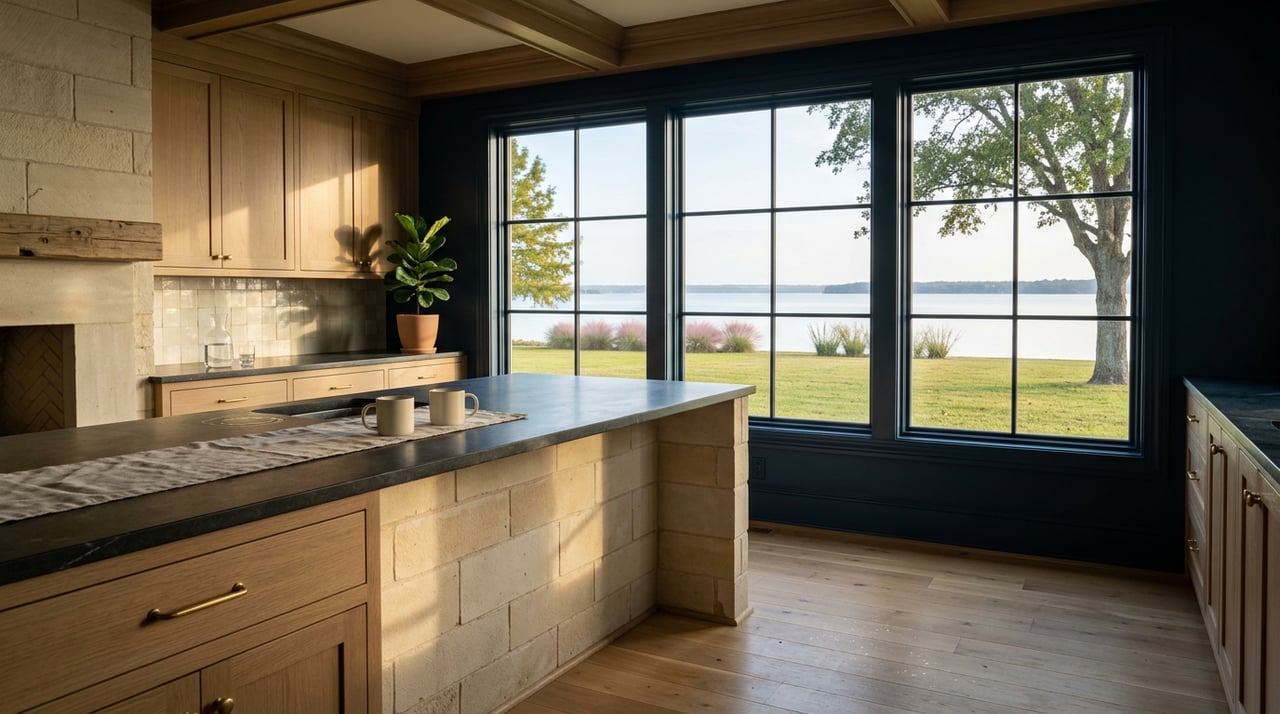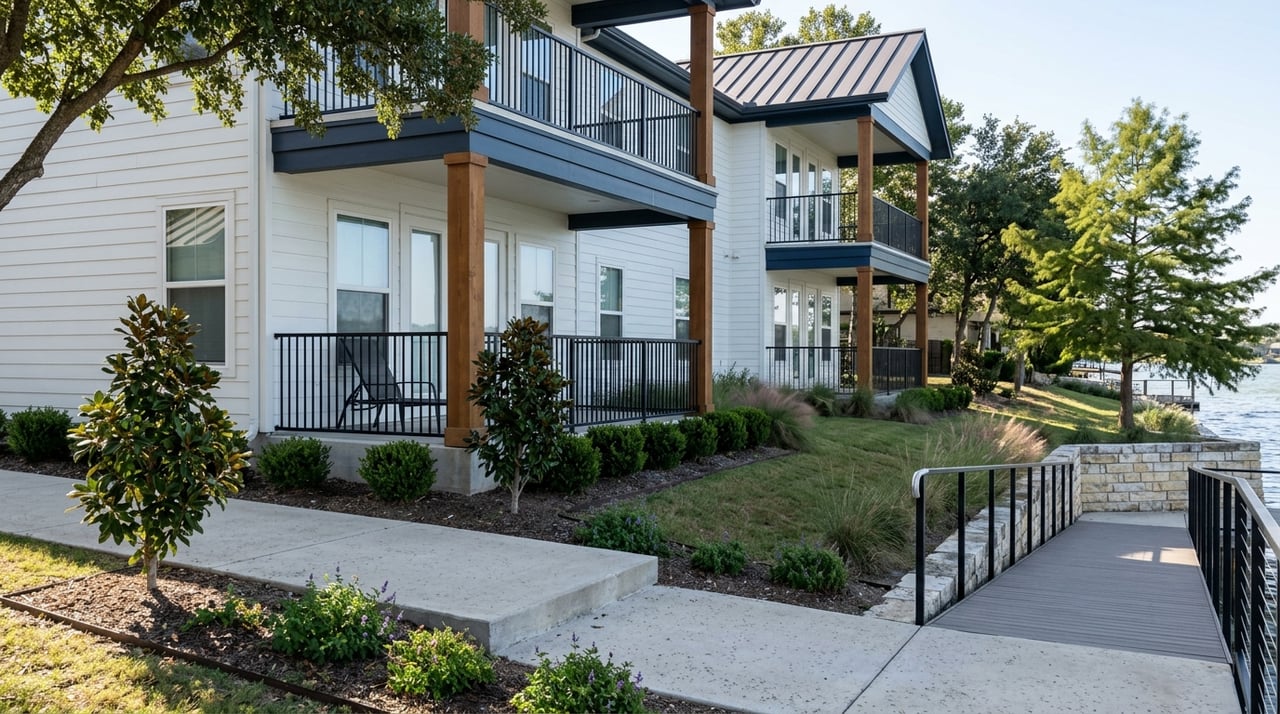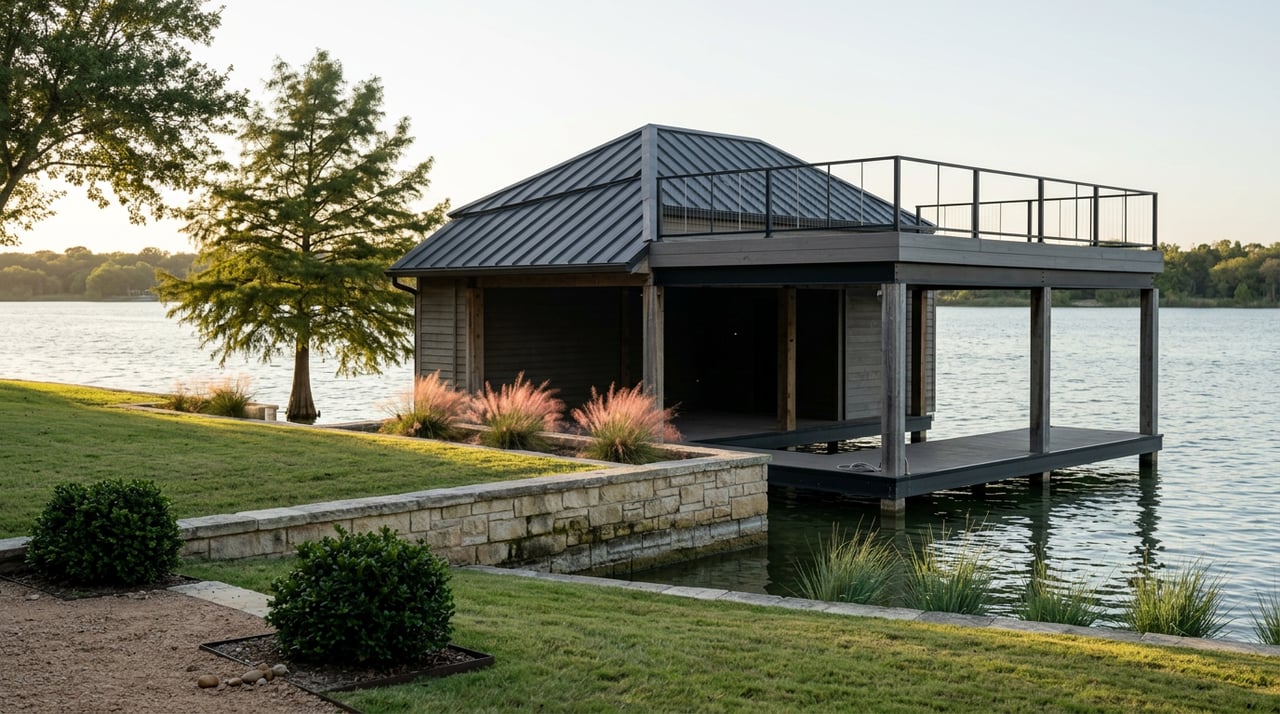
The listing photos are what sell it every time: a private boathouse with a covered slip, a party deck up top, string lights over the water. On Richland Chambers, that image is not marketing gloss. It is one of the real reasons buyers choose this lake over the ones closer to Dallas. But the paperwork behind that boathouse gets almost no attention until a title company or an appraiser asks for it, usually about a week before closing, and the seller realizes they are not sure where the permit is.
Here is the thing most buyers don't know until they are already under contract: the privilege that makes Richland Chambers boathouses so valuable is also the reason the permit question is worth asking early, not late.
Why This Lake Allows What Other North Texas Lakes Won't
Richland Chambers sits under the authority of the Tarrant Regional Water District rather than the U.S. Army Corps of Engineers, and that single fact changes what property owners are allowed to build. TRWD supplies water for Tarrant County, including the city of Fort Worth, and activity on the lake is governed by the district's own General Ordinance in addition to state and federal boating law.
That regulatory setup is why private, elaborate boathouses with covered slips and second-story decks are a normal feature here. On a Corps-controlled reservoir like Grapevine Lake, new dock construction is largely off the table, and buyers who want a boathouse there are often limited to purchasing an existing permitted structure rather than building one. Richland Chambers owners can apply for a new Improvement Permit and build to their own specifications, which is the single biggest driver of why waterfront lots here command what they do.
The tradeoff is that this freedom runs through an actual permitting apparatus, not a handshake. Every dock, boathouse, retaining wall, or significant piece of shoreline landscaping needs a specific Improvement Permit from TRWD, and that permit is tied to the improvement, not automatically renewed just because the seller says it's fine.
Three Numbers That Matter More Than the Square Footage
Any listing sheet will tell you square footage, bedroom count, and whether the dock has a lift. Almost none will tell you where the property sits relative to three elevation lines that actually govern what can be built and where.
TRWD's own guidelines set the conservation, or full pool, elevation of Richland Chambers at 315.00 feet above mean sea level. The current 100-year flood level is 318.00 feet. Because of the flooding risk between those two points, the district purchased a flood easement covering everything between 315.00 and 320.00 feet, and nothing permanent gets built inside that band without a permit.
That 320-foot line is the one to watch. Construction at or below it, whether it's a boathouse, a retaining wall, a walkway, excavation, or landscaping heavy enough to change drainage, requires the same Improvement Permit process. A survey that clearly marks where a structure sits relative to 315, 318, and 320 tells you more about what you're actually buying than the listing photos do.
Today's conditions make that easement line more than an abstraction. As of August 9, 2026, Richland-Chambers Reservoir is running at 94.6 percent of conservation capacity, which puts the working water level close enough to full pool that shoreline structures, seawalls, and any erosion along the bank are easy to inspect right now, before the lake's typical wet season and dry season swings move the shoreline again.
The Permit Clock Nobody Mentions at the Closing Table
TRWD's Improvement Permit process has its own timeline, and that timeline can quietly collide with a real estate closing if nobody checks it. Applicants should allow about 10 working days for the district to process an application. Once issued, a construction permit is valid for a period the district sets, with a minimum of 30 days and a maximum of 90, and any extension beyond that is granted at the district's discretion.
That window matters more than it sounds. If a seller started a retaining wall repair or a dock rebuild before listing the house, and the 90-day window lapses before the work is finished, the improvement can end up out of compliance right as a buyer's inspector walks the property. Buyers who plan to add a boathouse after closing should also build that same 10-day-plus-30-to-90-day clock into their post-closing timeline rather than assuming approval and construction happen on the buyer's schedule.
The district's rules go further than most buyers expect. Docks over 50 feet require lighting, and even shorter docks may need it depending on the circumstances. Contractors working on shoreline improvements must carry liability insurance with TRWD listed as the certificate holder, with no exceptions to that requirement. Even the materials are specified: approved seawall construction includes concrete, soil cement, steel sheet piling of at least 8 gauge, PVC sheet piling, pressure treated lumber, and rip rap, with other long-lasting materials considered case by case.
Since 2006, every permitted pier and boat dock has also been required to display the property owner's address on a weather-resistant aluminum sign with reflective letters at least four inches tall, visible from the water. It is a small detail, but it is a fast way to confirm in person that a structure's signage matches the parcel you are buying, rather than a neighbor's.
What the Guidelines Don't Say
Here is the part that catches people off guard. Other reservoir authorities spell out exactly what happens to a shoreline permit when a property changes hands. On lakes managed by the Tennessee Valley Authority, for example, permits explicitly do not transfer automatically with the sale, and the new owner is required to apply for their own permit within 60 days of closing.
TRWD's published guidelines for Richland Chambers describe how to apply for a permit and what happens if a structure falls out of compliance, but they do not spell out a transfer process the way TVA does. That silence is not the same as a guarantee that a permit follows the deed. It means the responsible move is to confirm directly with the district rather than assume the paperwork transfers the way title insurance does.
Before You Write an Offer on a Boathouse Property
A few steps turn this from a closing-week scramble into a non-issue:
- Ask the seller for the TRWD permit number for every shoreline structure, not just the dock
- Confirm the aluminum address sign and reflectors required since 2006 are actually in place and match the parcel
- Get a survey that marks the 315, 318, and 320 foot elevation lines relative to the boathouse, retaining wall, or seawall
- If work is in progress, find out when the permit was issued and whether the 30 to 90 day construction window is still open
- Call TRWD's Richland Chambers office directly to confirm permit status rather than relying on the seller's word alone
None of this is complicated. It just has to happen before closing rather than after.
A Few Questions Buyers Ask Us Often
Does a boathouse permit automatically transfer to a new owner on Richland Chambers? TRWD's published guidelines do not spell out an automatic transfer the way some other reservoir authorities do. The safer assumption is to confirm current permit status with the district before you close, not after.
What elevation should I care about most when looking at a waterfront lot? The 320.00 foot line matters most for buyers, since that marks the outer edge of TRWD's flood easement, below which any construction needs an Improvement Permit. The 315.00 foot conservation level and 318.00 foot 100-year flood level give you the rest of the picture.
Can I build a brand new boathouse from scratch here? Yes, with a TRWD Improvement Permit, which is precisely what sets Richland Chambers apart from a Corps-controlled reservoir like Grapevine Lake, where new dock construction is largely restricted.
Richland Chambers rewards buyers who know its rules and quietly costs the ones who don't ask. If you are looking at a waterfront property here, whether it already has a boathouse or you are hoping to build one, John Teel and the team can walk the permit history with you before you're locked into a contract. Contact us to talk through what a specific property's paperwork actually says.