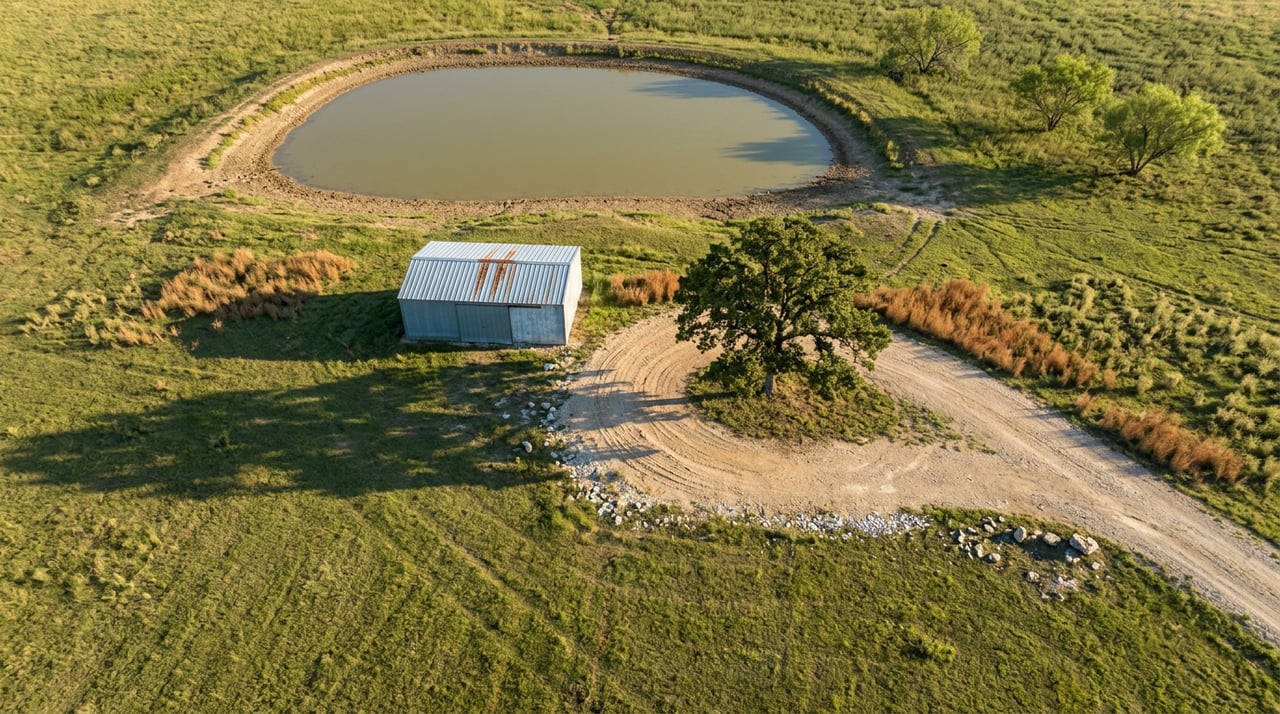
Say you find twelve acres a few miles outside Powell, priced right at what every land site tells you is the county average. You run the math, it pencils, you start picturing a barn and a long gravel drive off Farm Road 653. Then your option period starts and three things surface that the listing price never mentioned: the water isn't a utility hookup, it's a membership. The septic system might not need a permit at all, which sounds like good news until your lender asks for one. And the title commitment comes back with a mineral reservation dating to a century-old oil boom you didn't know Powell ever had.
None of that shows up in the number everyone quotes. That's the point.
The Number Everyone Quotes Is Three Markets Wearing One Coat
Ask what land costs near Powell and you'll get an answer with real confidence behind it, usually somewhere in the low-to-mid five figures per acre. The trouble is that figure is stitched together from properties that have almost nothing in common. As of mid-2026, raw farmland tracked separately across land marketplaces averaged closer to $10,400 an acre. Broker-listed parcels, a mix of raw and lightly improved ground, ran nearer $14,300. Properties that already had a house sitting on them, water and septic in place, averaged more than $40,700 an acre. Blend all three together into one countywide figure and you land somewhere around $23,000, a number that describes none of the actual tracts on the ground.
This matters for a specific reason: Powell isn't a subdivision with a homeowners association setting uniform standards. It's a scattering of parcels along Farm Road 653 and State Highway 31, some carrying working infrastructure and some carrying none, and the price tag alone won't tell you which kind you're looking at. A twelve-acre tract at $8,000 an acre and a twelve-acre tract at $28,000 an acre can sit a mile apart, and the gap between them is rarely about the dirt. It's about what's already been built, permitted, and paid for underneath it.
That's where the real due diligence starts, and where most buyers stop reading the listing and start making calls.
Water Isn't a Utility Bill Out Here, It's a Membership
There's no municipal water line running past most of Powell. The area is served by Chatfield Water Supply Corporation, a member-owned utility headquartered right in town on Carr Street. That distinction changes how you should think about a tract before you write an offer.
Chatfield's own service agreement spells out the terms plainly: the property owner of record is the official corporation member, not a renter or a future occupant, and each meter supplies exactly one dwelling. There's no extending pipe from one property to another to share service, resell it, or sub-meter a second structure off the existing connection. If your plan for that twelve acres includes a guest house, a second home for a family member, or splitting the tract down the road, you're not looking at a plumbing question. You're looking at a separate membership and a separate meter, which means separate fees and a separate application before anyone turns a valve.
Ask the seller directly whether the membership transfers with the sale or whether you'll be applying fresh. Ask what the property currently has, one meter or more. It's a five-minute phone call to Chatfield's office, and it's the kind of question a generic acreage checklist never tells you to make.
The Ten-Acre Rule That Sounds Like a Break But Isn't a Free Pass
Texas gives rural landowners a genuine exemption that shows up constantly in areas like Powell where tracts run large. Under the state's Health and Safety Code, a single-family home on ten acres or more, with no effluent crossing the property line, can skip the formal septic permitting process altogether. On paper, that sounds like one less hurdle.
In practice, it's a trap for anyone who doesn't read the fine print. The exemption waives the permit application, not the underlying design and setback standards, which still apply in full. And because there's no permit on file, there's no public record proving the system was ever installed correctly. That's rarely a problem for the person who built it. It becomes a problem for the next buyer, whose lender wants documentation that doesn't exist, or for the seller down the line who has to scramble to get a system inspected and retroactively verified before closing can happen.
If you're buying a Powell-area tract that already has a home and a septic system in place, ask for whatever paperwork exists now, before you're the one trying to produce it in escrow. If you're buying raw acreage to build on, factor the site evaluation and design work into your budget from day one rather than assuming the acreage exemption means the cost disappears. It doesn't. It just moves the cost from a permit fee to a bill from a licensed site evaluator.
A Hundred-Year-Old Oilfield Still Shows Up in the Title Search
Powell has a history most buyers don't expect to find attached to a rural tract. The Corsicana oilfield, discovered in 1894 just west of town, was the first commercially significant oil strike in Texas. Its success sent prospectors fanning out across the county, and that search turned up the Powell oilfield in 1900. For a stretch of the early twentieth century, this was an active, working oil town, not the quiet farm-to-market community it is today.
Deeds written during and after that era in Texas frequently carved the mineral estate away from the surface estate, reserving oil and gas rights to a prior owner while selling the surface to someone else. That reservation doesn't expire on its own, and it survives every sale that comes after it unless the language in the deed says otherwise. It won't stop you from building a house or running cattle. What it does is show up as an exception on your title commitment, and it means the person who technically owns what's under your land might not be you.
For most buyers this is a non-event, a line item the title company flags and everyone moves past. But it's worth actually reading rather than skimming, and worth asking your title company directly whether the mineral estate is intact or severed on the specific tract you're under contract on. On land with Powell's history, that's not a hypothetical question. It's one with a real, documented reason behind it.
What This Means Before You Write an Offer
Put the three pieces together and a pattern emerges. The sticker price on a Powell-area tract tells you almost nothing about what you're actually buying until you know whether the water membership transfers, whether the septic system carries documentation or relies on the acreage exemption, and whether the mineral estate came with the surface or was reserved away decades ago. None of those three things move the listing price. All three move what the property is actually worth to you.
Before you write an offer on acreage near Powell, it's worth confirming:
- Whether the water connection is an existing Chatfield membership tied to the seller, or something you'll be applying for fresh
- Whether there's a septic permit on file, or the property is relying on the ten-acre exemption with no paper trail
- What the title commitment says about the mineral estate, and whether it's intact or severed
These aren't deal-breakers on their own. Plenty of good tracts near Powell carry a severed mineral estate or an unpermitted but perfectly functional septic system. The point isn't to avoid those properties. It's to know which property you're actually buying before the option period runs out and the earnest money stops being fully refundable.
A Few Questions Buyers Ask Us Often
If a tract is 10 acres or more, does that always mean I won't need a septic permit? Not automatically. The exemption applies only when the property has a single-family dwelling, no other structures, and no effluent crossing the property line. The design and setback rules still apply even without a formal permit, and it's worth confirming the specifics with the county before assuming the exemption covers your plans.
If Chatfield Water already serves the property, can I add a second structure on the existing meter? No. Each meter is tied to one dwelling under Chatfield's service terms, and there's no sharing or extending service between structures on the same account. A second home or guest house means a second membership application.
How do I find out if mineral rights were severed before I close? Your title company will flag any mineral reservation as an exception on the title commitment. Read that section closely and ask directly whether the estate is intact or severed rather than assuming it's standard boilerplate.
Buying acreage near Powell rewards patience more than speed. The tracts that look identical on a listing sheet often aren't, and the difference usually lives in paperwork the price tag never mentions. John Teel spent the years before he became an agent building and remodeling homes in this part of Navarro County, so questions about water membership, septic history, and mineral title aren't an afterthought, they're the first thing he asks about any tract before a client writes an offer.
If you're comparing acreage near Powell against other parts of Richland Chambers Lake country, John Teel can walk you through what a specific tract actually carries before you're the one finding out in escrow. Contact Us.