530 people live in Powell, where the median age is 37.7 and the average individual income is $26,133. Data provided by the U.S. Census Bureau.
Total Population
Median Age
Population Density Population Density This is the number of people per square mile in a neighborhood.
Average individual Income
Powell is the kind of place people move to when they want elbow room. Tucked into Navarro County just east of Corsicana, this small rural community trades sidewalks and subdivisions for pasture, pond, and open sky. There is no downtown strip and no master-planned entrance monument — instead, homes sit on acreage down county roads and farm-to-market highways, with State Highway 31 serving as the main artery west into Corsicana and beyond.
The buyers Powell attracts tend to know what they want: land, quiet, and distance from the density of the Dallas-Fort Worth metroplex. It draws country-living enthusiasts, buyers priced out of the suburbs looking further out for affordability, hobby-farm owners, and families who value small-town rhythm over convenience. Powell sits close enough to Richland-Chambers Reservoir to appeal to lake-minded buyers, while remaining a genuinely rural community rather than a resort one. If the goal is walking to a coffee shop, this is the wrong town. If it is watching the sun set over your own acreage, it is exactly right.
The Powell market is relaxed and low-competition. Homes here do not sell overnight, and multiple-offer bidding wars are rare — buyers generally have time to inspect, negotiate, and think before committing. That pace is a feature of rural markets, not a warning sign.
As of mid-2026, the median sale price sits around $220,000, with the broader range running from roughly $110,000 for smaller land parcels and fixer-uppers up past $250,000 for single-family homes on acreage. Homes average about 67 days on the market before selling, and truly unique properties can take several months to find the right buyer. Sales typically close slightly under asking price, which means buyers carry meaningful negotiating leverage and sellers should expect to be flexible on price or concessions.
One caveat worth understanding: Powell is a small town with low transaction volume. A single higher-priced sale can swing the statistics dramatically, so any month-to-month figure should be read as a rough guide rather than a precise benchmark.
Even with thin sales volume, prices in Powell have trended upward — median home prices were up roughly 12.8% year-over-year for a three-month window ending in Spring 2026. That figure comes with the same asterisk as everything in a small market: with so few sales, one or two premium properties can inflate the percentage, so the underlying trend matters more than the headline number.
The larger force behind Powell's market is the "space premium." As DFW suburbs an hour northwest continue to climb in price, buyers chasing affordability and open land keep pushing outward, and Powell benefits from that overflow. The demand here is specifically for acreage, manufactured-home-friendly lots, and quiet country living rather than move-in-ready suburban product.
At the same time, Powell mirrors the broader Texas trend of 2025 into 2026: softening prices and rising inventory statewide. Locally that translates to steady-but-not-surging values, longer listing times, and a market where sellers who price realistically get the buyers who are still working around elevated mortgage rates.
Anyone expecting model homes and a community pool will need to reset expectations. New construction in Powell is decentralized and personalized — there are no production subdivisions here.
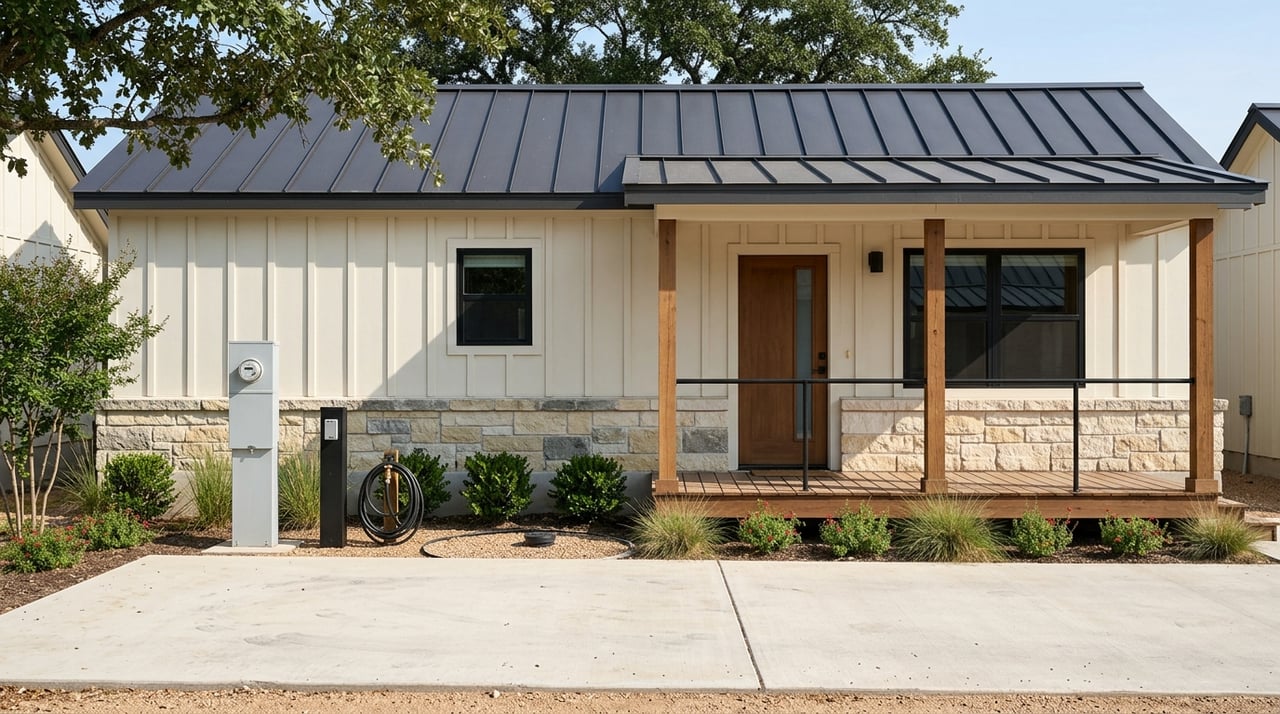
The dominant path is build-on-your-own-land (BOYL). Buyers typically purchase raw land first, then hire a regional "on-your-lot" builder to construct a custom home on the parcel. Two builders come up most often in this part of rural Texas:
Building in Powell means thinking like a developer rather than a homebuyer. A lot is rarely plug-and-play — expect to budget both time and money for clearing trees, grading the land, and bringing in utilities, which can mean running electrical lines from the nearest road and arranging a connection to a local water co-op. The payoff is a home built exactly to specification on land you chose.
Buying here is slower and more methodical than in Corsicana, let alone Dallas. Inventory is sparse — often fewer than ten active listings at any given time — and it clusters into three property types: manufactured and modular homes (a popular, budget-friendly option, usually on one to five acres), traditional ranch homes, farmhouses, and modern barndominiums on larger tracts, and unimproved raw land ranging from one-acre lots to twenty-plus-acre agricultural tracts.
Competitiveness is very low. Because homes routinely sit for 60 days and sometimes well past 180, buyers hold real leverage — room to negotiate price, ask for seller concessions like a rate buy-down, and take their time with due diligence.
What sets Powell apart is the due diligence itself. In a suburban purchase, the main contingencies are financing and a standard inspection. In rural Navarro County, three additional contingencies are non-negotiable:
Selling in a small rural market takes a different playbook than moving a suburban tract home, and the two biggest levers are pricing and preparation.
On pricing, resist the "test the market" instinct. In hot metros a seller can overprice and let negotiation bring it down; in Powell, overpricing is the fastest way to let a listing go stale. Median price sits near $220,000, and properties with significant acreage can climb higher — but with homes averaging 67 days on market and unique listings sometimes needing 180-plus, an aggressive price simply signals to buyers that something must be wrong. Pricing conservatively against real comparable sales across the broader county is what keeps a listing moving.
On presentation, remember that buyers here are evaluating the land as much as the house. That means acreage curb appeal: clearing overgrown brush, defining property lines, mowing pastures, and making sure barns, sheds, and workshops are swept out and structurally sound. Wash the windows and open every blind — rural buyers want to see the Texas landscape. And get ahead of the big-ticket systems by having the septic pumped and inspected before listing and the well or water co-op documentation organized and ready. Demonstrating that the expensive rural systems are healthy builds immediate buyer confidence.
A few pieces of boots-on-the-ground advice that matter specifically here:
Verify the ag-exemption status. On larger parcels (typically 10-plus acres) carrying an agricultural tax valuation, understand what it takes to keep it. Losing an ag exemption can cause property taxes to spike overnight, and maintaining it requires continued qualifying activity like leasing for cattle or hay production.
Test the well and septic during your option period. If there's a well, pay for a potability and flow-rate test to confirm the water is safe and yields enough gallons per minute. For septic, pay for a specialized inspection. Skipping either can turn into a multi-thousand-dollar surprise later.
Test the internet — literally. High-speed fiber isn't guaranteed in rural Navarro County. If you work from home, don't take the listing agent's word for it. Check signal strength on your phone during the showing and call satellite or fixed-wireless providers to confirm what actually reaches that specific address.
Get a brand-new survey. Older rural property descriptions can read like riddles ("starting at the large oak and heading east to the creek"). A current professional survey tells you exactly where your lines — and your neighbor's fences — actually sit.
The offer strategy that wins in Dallas is the wrong strategy in Powell. Here, flexibility beats firepower.
Because listings often sit past 60 days, sellers tend to be realistic, and a smart opening offer often lands 5% to 10% below list — especially on a home that's been available for more than two months. Rather than only cutting price, use that leverage to ask the seller to cover closing costs or fund a temporary rate buy-down (such as a 2-1 buy-down) to soften the monthly payment.
Escalation clauses are unnecessary here — multiple-offer scenarios are rare, and in the unusual event another offer appears, the listing agent is obligated to disclose it, at which point you can choose to raise your price directly. Winning in Powell isn't about waiving inspections or paying cash over appraisal. It comes down to two things: a solid pre-approval from a lender experienced with rural properties (sellers are wary of financing falling through on homes with septic, wells, or manufactured construction), and a clean, respectful contract that keeps your inspection and survey contingencies intact while offering a reasonable 30-to-45-day close.
Powell is a car-dependent country town, and it is honest to say so up front. The Walk Score is effectively zero — no sidewalks, no pedestrian districts, no concentrated retail. Groceries, school, and dining all require a vehicle. There is no bike infrastructure; the surrounding roads are rural state highways like SH-31 and county farm-to-market routes not built for casual cycling. There is also no public transportation of any kind — no bus routes, no commuter rail, no park-and-ride. Residents rely entirely on personal vehicles.
What Powell lacks in walkability it makes up for in position. It sits in a genuinely convenient spot for regional commuters:
The trade-off is straightforward: foot-traffic convenience for peaceful acreage. The daily "walk" is more likely down your own driveway, and the commute runs across open Texas highway rather than bumper-to-bumper city traffic.
School zoning is one of the first questions family buyers ask, and Powell's answer is simple. Because Powell is a small unincorporated community without its own district, students are zoned to the neighboring Kerens Independent School District (Kerens ISD).
Kerens ISD runs as a consolidated rural district, housing students on a centralized campus in Kerens, about 7 miles east of Powell. All local public students attend Kerens School, serving pre-kindergarten through 12th grade under one unified system.
For a rural Texas district, Kerens performs well, holding a solid "B" overall rating from the Texas Education Agency and scoring especially well on student growth — a sign that its teachers are effective at moving kids forward year over year. Total enrollment sits around 650 students across all grades, which keeps class sizes small and allows a level of personal attention that's hard to find in fast-growing suburban districts. And because everyone attends the same campus, the school functions as the community's center of gravity — Friday-night football, FFA events, and school fundraisers are where the town gathers.
For most Powell residents, the primary outdoor space is their own backyard or acreage. But the recreation just beyond the property line is a genuine draw.
The headline is Richland-Chambers Reservoir, sitting just south of town — the third-largest inland reservoir in Texas, with 330 miles of shoreline. It's a regional magnet for boating and jet-skiing, and it ranks among the state's premier spots for crappie, white bass, and channel catfish. Public access points like Highway 309 Park, along with private marinas such as Fisherman's Point, offer boat ramps, swimming, and campgrounds.
For traditional playgrounds, sports fields, and walking paths, residents make the short drive into Corsicana. Lake Halbert Park is a scenic 145-acre lakeside park with trails, playgrounds, splash pads, and picnic areas, and Corsicana maintains close to 20 community parks. The bottom line: big-water recreation and well-kept regional parks both sit less than 15 minutes from a Powell front door.
Powell's food and evening scene reads as a lifestyle signal more than a restaurant directory — and the signal is "slow, quiet, and neighborly." There are no cocktail lounges, sushi bars, or late-night clubs. Day-to-day dining leans on nearby roadside diners, convenience stores, and independent burger spots along Highway 31.
When a sit-down dinner or date night calls for more, residents head 10 minutes west into Corsicana, where the historic downtown offers steakhouses, Mexican food, Texas BBQ, and local pizza favorites. Nightlife, such as it is, means a cold beer at a casual bar or icehouse in Corsicana — or, more likely, a sunset over Richland-Chambers. Social life here tends to happen around backyard firepits, neighborhood fish fries, and Friday-night high school games rather than a bar district.
Property taxes deserve real attention because Texas has no state income tax, which means local services and schools are funded largely through property tax — and it's a line item too many neighborhood guides skip.
The good news for Powell buyers: the community sits in an unincorporated pocket of Navarro County, so residents pay no city-level property tax, which keeps the overall rate competitive. A Powell tax bill is assembled from several county and school entities:
Taxing Entity | Approx. Rate (per $100) |
|---|---|
Kerens ISD (school district) | $0.9892 |
Navarro County General Fund | $0.3445 |
Navarro Road & Bridge / Flood Control | $0.0752 |
Navarro College District | $0.1001 |
Navarro County Emergency Services District #1 | $0.0426 |
Summed together, the estimated total rate lands around 1.55% of assessed value. On a home assessed at the local median of $220,000, that's roughly $3,410 per year before exemptions.
Two exemptions can meaningfully lower that bill. The Texas Homestead Exemption, available on a primary residence, removes $100,000 from the assessed value for the school-district portion — worth roughly $990 a year. And on qualifying raw land or larger ranch parcels used for livestock, hay, or timber, an agricultural valuation taxes the land on its productivity value rather than market value, which can save thousands annually.
Powell rewards buyers and sellers who understand how rural Navarro County actually works — the septic and well inspections, the water-co-op tap questions, the ag-exemption rules, the boundary surveys that keep a country purchase from turning into a headache. That local knowledge is exactly what The Teel Team at RE/MAX Lakeside Dreams brings to the table.
Julie and John Teel and their team have closed transactions across this market, from acreage tracts and county-road ranches to lake-area homes near Richland-Chambers. Whether the goal is finding the right parcel to build on, pricing a rural property so it actually sells, or simply understanding what life in Powell looks like day to day, the team is available to help from start to finish.
To start a conversation about buying or selling in Powell, reach out to The Teel Team at RE/MAX Lakeside Dreams — a local resource for the Richland Chambers Lake area, here to answer questions whenever you're ready.
There's plenty to do around Powell, including shopping, dining, nightlife, parks, and more. Data provided by Walk Score and Yelp.
Powell has 146 households, with an average household size of 3.63. Data provided by the U.S. Census Bureau. Here’s what the people living in Powell do for work — and how long it takes them to get there. Data provided by the U.S. Census Bureau. 530 people call Powell home. The population density is 22 and the largest age group is Data provided by the U.S. Census Bureau.
Total Population
Population Density Population Density This is the number of people per square mile in a neighborhood.
Median Age
Men vs Women
Population by Age Group
0-9 Years
10-17 Years
18-24 Years
25-64 Years
65-74 Years
75+ Years
Education Level
Total Households
Average Household Size
Average individual Income
Households with Children
With Children:
Without Children:
Marital Status
Blue vs White Collar Workers
Blue Collar:
White Collar: